
How to Transport Refrigerant Cylinders in a Work Van or Truck (DOT & OSHA Rules)
Yes, an HVAC contractor can carry refrigerant cylinders in a work van or pickup without full hazmat paperwork when they qualify as DOT “materials of trade”: each gas cylinder may weigh up to 220 lb gross, the vehicle total may not exceed 440 lb, and every cylinder must be secured against shifting.
This guide walks through the federal rules that apply when you load refrigerant, nitrogen, oxygen and acetylene on a service truck, using the text of the regulations themselves: 49 CFR 173.6 (materials of trade), 49 CFR 177.834 (securing packages) and OSHA 29 CFR 1910.253 (oxygen and fuel-gas storage). State and local rules can add requirements, so treat this as a starting point.
Is it legal to carry refrigerant cylinders in a work van?
Yes. DOT defines a “material of trade” as hazmat a private motor carrier hauls in direct support of a non-transportation business (49 CFR 171.8). An HVAC company carrying refrigerant to service calls fits, so the simpler rules in 49 CFR 173.6 apply instead of full hazmat shipping rules.
When every condition in 173.6 is met, the regulation says the material “is not subject to any other requirements” of the Hazardous Materials Regulations besides those in that section. That is why most contractors never deal with placards or shipping papers for a normal service load.
How much refrigerant can I carry under the materials-of-trade exception?
Under 49 CFR 173.6(a)(2), each Division 2.1 or 2.2 gas cylinder may have a gross weight of up to 100 kg (220 lb). Under 173.6(d), all materials of trade on one vehicle combined may not exceed 200 kg (440 lb) gross. Gross weight means the cylinder plus its contents.
| Limit | What the rule says | Source |
|---|---|---|
| Per cylinder (Division 2.1 or 2.2 gas) | Up to 100 kg (220 lb) gross weight | 49 CFR 173.6(a)(2) |
| Per vehicle (all materials of trade) | Up to 200 kg (440 lb) aggregate gross weight | 49 CFR 173.6(d) |
| Packaging | Leak tight, securely closed, secured against shifting, protected against damage | 49 CFR 173.6(b)(1) |
| Cylinder spec | Must meet DOT packaging, qualification, maintenance and use rules; outer packaging not required | 49 CFR 173.6(b)(5) |
| Driver | Must be told hazmat is on board and told the requirements of 173.6 | 49 CFR 173.6(c)(5) |
Refrigerant cylinders hold compressed gases classed as Division 2.2 (non-flammable) or Division 2.1 (flammable). Check the DOT hazard class in Section 14 of the refrigerant’s Safety Data Sheet before you plan a load.
How do refrigerant cylinders have to be secured in a truck?
They must not be able to move. 49 CFR 177.834(a) requires any hazmat package not permanently attached to the vehicle to be secured against shifting, and packages with valves to be loaded to minimize damage. Section 173.6(b)(1) repeats the “secured against shifting” rule for materials of trade.
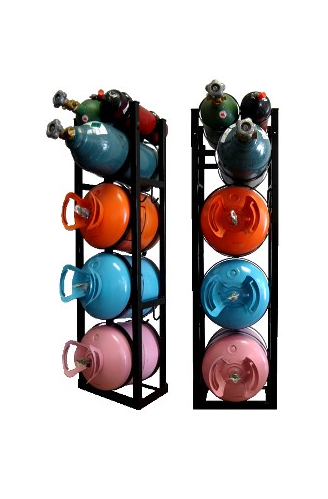
Loose cylinders in bins can roll and strike valves under hard braking. A steel rack bolted to the vehicle keeps each cylinder in its own position and keeps valves away from impact. The CoolMaster 3×30 lb refrigerant tank rack suits a lighter daily load, the 4×30 lb rack covers a full service day, and the 4×50 lb rack is sized for larger cylinders.
What does the driver need to know?
Under 49 CFR 173.6(c)(5), the operator of a vehicle carrying materials of trade must be informed that hazardous material is on board and of the requirements of section 173.6. DOT-specification cylinders, other than DOT-39 disposables, must also be marked and labeled as the regulations prescribe (173.6(c)(3)).
In practice, a short written truck policy covering cylinder limits, securing, and valve caps, plus a sign-off from each tech, is an easy way to document that drivers were told.
Are A2L refrigerant cylinders like R-454B and R-32 handled differently?
The securing rules are the same, but the cylinders look different. AHRI Guideline N calls for a red band on the shoulder or top of containers holding flammable refrigerants. Refrigerant maker Arkema notes A2L cylinders also use a resettable pressure-relief valve and a left-hand-thread port (Arkema Forane).
EPA lists R-454B (GWP 470) and R-32 (GWP 675) as A2L refrigerants for new equipment, while R-410A (GWP 2,090) is A1 (EPA SNAP). Keep A2L and A1 cylinders clearly separated on the rack so techs never grab the wrong one.
Can oxygen and acetylene ride on the same truck rack?
For transport, both must be secured against shifting like any other cylinder. Storage is different: OSHA 29 CFR 1910.253(b)(4)(iii) requires stored oxygen cylinders to be at least 20 feet from fuel-gas cylinders or separated by a 5-foot barrier with a half-hour fire rating.
OSHA also requires acetylene cylinders to be stored valve end up. That means a truck rack is for moving cylinders, not for long-term storage. For brazing setups, look at the 2×30 lb refrigerant + nitrogen/oxygen/acetylene rack, the 3×30 lb version or the 1×50 + 2×30 lb rack.
Which CoolMaster rack fits my truck?
| Rack | Holds | SKU | Price (as listed) |
|---|---|---|---|
| 3×30 lb refrigerant | Three 30 lb refrigerant cylinders | TH330 | $299.99 |
| 4×30 lb refrigerant | Four 30 lb refrigerant cylinders | TH430 | $299.99 |
| 4×50 lb refrigerant | Four 50 lb refrigerant cylinders | TH450 | $299.99 |
| 2×30 lb refrigerant + N2/O2/acetylene | Two 30 lb refrigerant cylinders, plus nitrogen, oxygen and acetylene holders | TH230NAOTK | $299.99 |
| 3×30 lb refrigerant + N2/O2/acetylene | Three 30 lb refrigerant cylinders, plus nitrogen, oxygen and acetylene holders | TH330NAO | $299.99 |
| 1×50 + 2×30 lb refrigerant + N2/O2/acetylene | One 50 lb and two 30 lb refrigerant cylinders, plus nitrogen, oxygen and acetylene holders | TH150230NAO | $299.99 |
All six racks are powder-coated tubular box steel, include a mounting kit, stand vertically or horizontally (per iGas) and ship from Florida. For a deeper comparison of layouts, read our guide to the best refrigerant rack for HVAC trucks.
Frequently asked questions
Do I need a hazmat endorsement to carry refrigerant in my work van?
Not when the load qualifies as materials of trade. Under 49 CFR 173.6, materials of trade that meet the section's limits are not subject to the other Hazardous Materials Regulations requirements. Stay under 220 lb gross per gas cylinder and 440 lb total per vehicle, and secure every cylinder.
Can refrigerant cylinders lie on their side in a truck?
The federal rules focus on securing cylinders against shifting and protecting valves (49 CFR 177.834(a)), not on a single orientation for refrigerant. Follow any orientation markings on the package and the refrigerant manufacturer's handling instructions on the Safety Data Sheet.
Do I need EPA 608 certification to buy the refrigerant I carry?
Generally yes. Under 40 CFR 82.154(c), refrigerant may be sold only to a buyer who is, or employs, an EPA Section 608 certified technician, with limited exceptions such as sales for resale.
Can I leave oxygen and acetylene on the truck rack overnight?
OSHA 29 CFR 1910.253(b)(4)(iii) requires oxygen in storage to be 20 feet from fuel-gas cylinders or behind a 5-foot, half-hour fire-rated barrier. Treat the rack as transport only, and store cylinders per OSHA at your shop.
How much does a CoolMaster refrigerant tank rack cost?
Chilly Air lists each CoolMaster tank rack, from the 3×30 lb refrigerant rack to the 1×50 + 2×30 lb refrigerant + nitrogen/oxygen/acetylene rack, at $299.99. They ship from Florida, with free shipping on qualifying orders.
Questions about fit or contractor pricing on multiple racks? Call or text 813-445-6228 or email orders@chillyairllc.com. Need refrigerant too? See our refrigerant lineup (contact for pricing).
Last updated: November 21, 2026. Sources: 49 CFR 173.6 – Materials of trade exceptions; 49 CFR 171.8 – Definitions; 49 CFR 177.834 – General requirements; 29 CFR 1910.253 – Oxygen-fuel gas welding and cutting; 40 CFR 82.154 – Refrigerant sales restriction; EPA SNAP – residential and light-commercial AC and heat pumps; AHRI Guideline N; Arkema Forane – A2L vs A1 cylinders. This article summarizes federal rules and is not legal advice.